
The Philosopy behind the way we work
We believe in the power of working in small projects reflecting incremental change, thereby constantly remaining agile and open for improvement. That way, it’s much easier to integrate gained knowledge and experience — also through mistakes — into the ongoing process. While preventing us from losing track of the big picture. This also reflects our attitude towards funding. Rather financing small incremental projects than relying on a big loan or subsidies. Because there is always the risk of getting stuck in tunnel-vision, having invested too much to change plands with ease or beeing considerably influenced in the decision-making process.
This process is mainly focused on projects building the Circular Outdoor Collective and the HAFH. But we are convinced that it can easily be adapted to bring about positive change in any environment or neighbourhood.
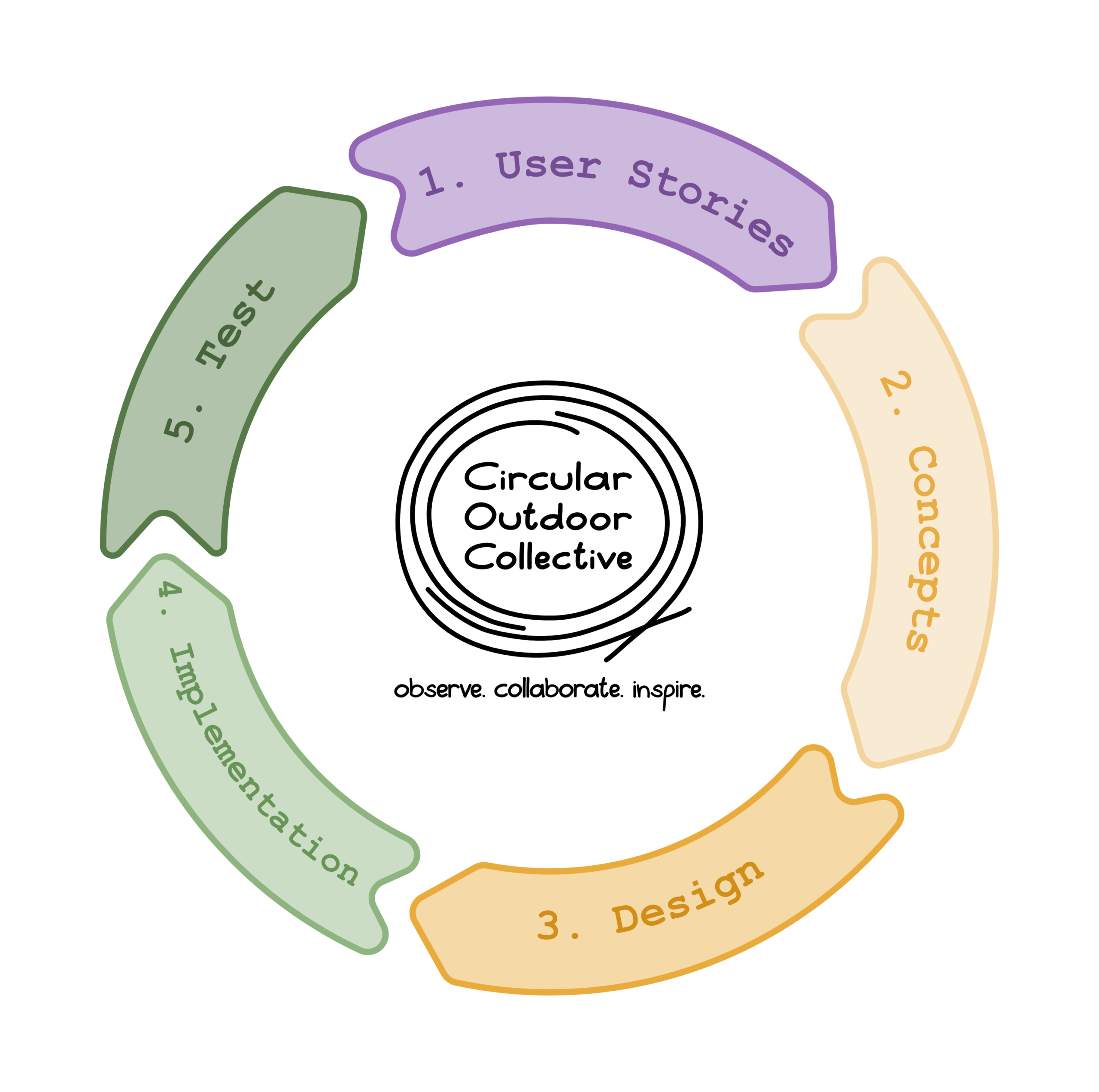
The circular process
Click on the different phases to learn more about our circular process
1. User Stories
A good solution starts with properly identifying the problem and naming all requirements. This could be done by so called User Stories: A collection of individual points of view of the ones using, interacting with or being affected by the changes we are considering. However, we take this approach a bit further and ask ourselves which non-individuals may be affected. This could be the ecosystem, social structures of the nearby community, as well as future generations. These stories may change or be extended with time and additional insight. Actually that’s the beauty of working and thinking in a circular way: there’s no beginning and no end, just iterations, allowing continuous improvement.
2. Concepts
Based on all the stories we’ve collected we start thinking about the wildest concepts that could fulfill their needs. The success of these first two phases highly relies on talking to others, frequently changing the point of view and not bending the requirements to fit predefined solutions in our heads. The concept phase will be concluded with an objective comparison of all concepts and the question which one will be taken to design. Sometimes the answer may also be: None.
3. Design
The Design phase entails most of the work. We define all specifications of the solution, build the team needed for implementation and maintenance, explore potential collaborations, create a timeline, set up a budget plan and predict the ecological, social and financial benefits of the project. At the end of this phase there’s THE review: users, participants, and those who will be affected by the project decide if the design is ready for implementation and wether it has the impact we’ve hoped for. When passing this review, we start funding: Everyone involved in, affected by, or just wanting to support the project can fund a part of it. In return supporters get a voucher representing the value of their funding, to be used for the products of the COC or their next stay at the HAFH.
4. Implementation
As soon as the project’s execution is financially covered by a predefined funding-threshold, its implementation starts. Our goal is to closely integrate the supporters and the Collective into that phase in all conceivable ways, since everyone has different strengths and passions to learn from. Thereby turning the realization of the project into a collective effort and gain.
5. Test
And finally we use it, test it, review our work, probably break and repair it and gather feedback. All insights will be shared. Because you never know who can benefit from them and put them to good use in another context. In the end: we don’t aim for permanence! So the next cycle will come for sure …
Current Projects
This part is still under construction
We are constantly working on the content for the COC. We can notify you if there is something new.